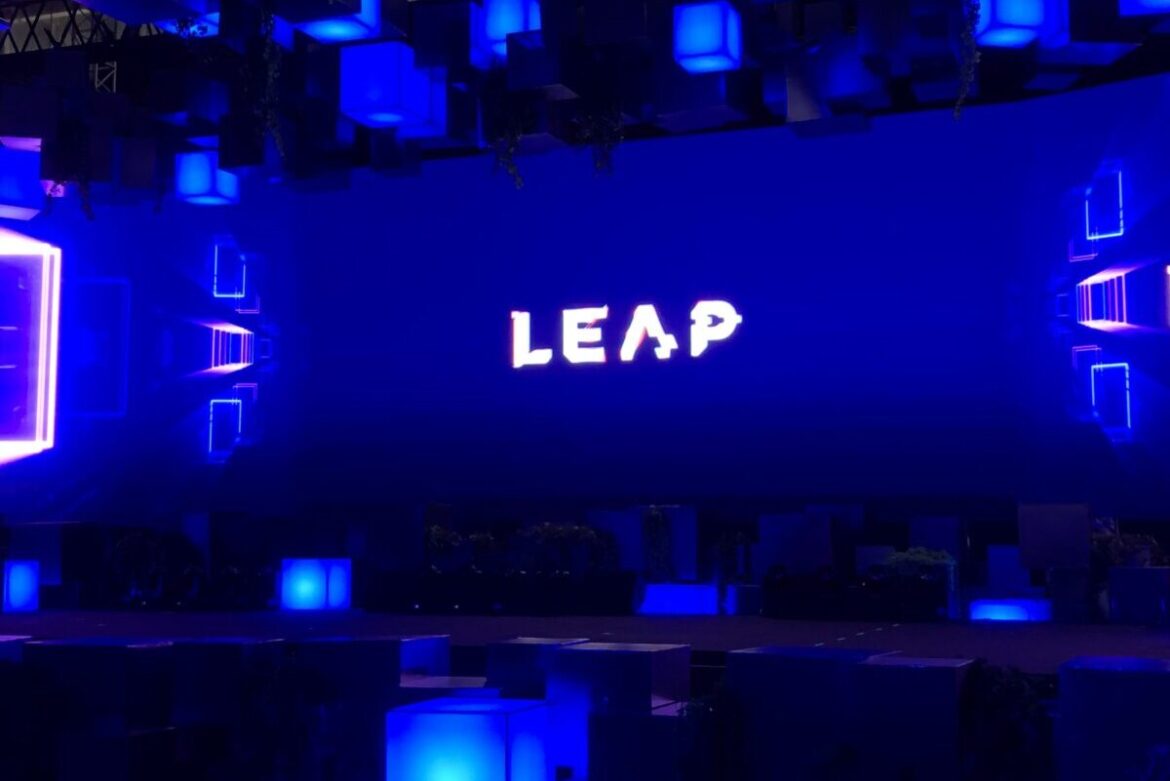
Riyadh, Saudi Arabia — LEAP opened its fifth edition in Malham this morning. For allocators with exposure to digital infrastructure in the Gulf, the value of the week is not the announcement volume. It is the opportunity to test, in one place, whether the Kingdom’s stated compute ambitions are matched by the power, the land and the offtake structures required to deliver them.
The Scale Being Underwritten
The anchor is HUMAIN, the state-owned artificial intelligence company launched in May 2025 and led by Tareq Amin, who speaks on the main stage this week. Reported positions, all pre-dating this event, include technology agreements of approximately $23bn with Nvidia, AMD, AWS, Cisco and Qualcomm, a $3bn commitment to xAI’s Series E, a $10bn venture vehicle for artificial intelligence startups, and twin 100 MW campuses under construction in Riyadh and Dammam. Amin has stated a target of 1.9 gigawatts of built data centre capacity by 2030, against a land position described as 211 plots with access to 14 gigawatts of power.
Nvidia is supplying silicon for a 500 MW build-out, with a first tranche reported at 18,000 Blackwell units. AMD has a $10bn collaboration with the company. AWS committed $5.3bn to Saudi data centres at LEAP 2024, part of a $10bn combined total across several firms, and has since added a separate AI Zone partnership with HUMAIN reported at more than $5bn. Microsoft has said its Saudi Arabia East region becomes available for customer workloads from the fourth quarter of 2026, with three availability zones in the Eastern Province and construction of the facilities completed.
Where the Analytical Work Sits
The distinction that matters to an underwriter is between announced capacity and contracted capacity. A land bank with access to 14 gigawatts is a development option, not a supply agreement. The disclosed record contains chip allocations, memoranda and site groundbreakings. It does not, publicly, contain the interconnection agreements, generation procurement or power purchase structures on which the 2030 targets depend.
This is not a Saudi-specific observation. Power delivery has been the binding constraint on AI data centre build-out in every established market, and it is the reason developers in the United States have moved into secondary locations with available utility capacity. The Saudi proposition is that land, power and capital can be assembled at speed under a single sovereign sponsor. That proposition is plausible and, so far, unevidenced in the public domain.
A second consideration is load profile. Training clusters draw close to nameplate for sustained periods, which sits poorly with intermittent generation absent substantial storage or firm backup. A programme of this scale in a high-irradiance market still requires a long-duration answer, and none has been published.
A third is disclosure. Enterprise buyers in Europe and North America carry reporting obligations that will eventually require the carbon and water intensity of the capacity they rent. That question has not yet been pressed hard in the region, and it is more likely to arrive from customers than from regulators.
What the Week Actually Establishes
The ministerial framing ahead of the opening is worth recording. Communications and information technology minister Abdullah Al-Swaha said Saudi Arabia has exported more than 3,000 locally manufactured servers to neighbouring countries, positioning the Kingdom as a producer rather than a purchaser. He put the digital economy at around SAR 522bn, roughly $139bn, up more than 75 per cent since Vision 2030 began, with 410,000 sector jobs, more than 80 technical schools and approximately 30,000 people trained in artificial intelligence. The ministry put cumulative announced investment across the four Riyadh editions at more than $44.2bn.
Three thousand servers is a modest figure in absolute terms. As an indicator of intent to move up the value chain it is more informative than the headline investment totals, which have historically been assembled from memoranda of varying enforceability.
On the capital side, LEAP reports 1,289 registered investors from 1,016 firms representing $14.5tn in combined assets under management. A separate government release cites 1,900 investors. Both figures are organiser-supplied, they are not reconciled, and neither has been independently verified. Named participants include the Public Investment Fund, Sanabil Investments, General Atlantic, J.P. Morgan, Morgan Stanley and Aramco Ventures.
Calendar and Context
LEAP was originally scheduled for April and moved to the end of August following regional disruption to travel and logistics. Organisers framed the change as consultation with partners rather than postponement. Prior editions have run in February or March, and the August date carries a genuine question over international attendance, which reached a reported 201,000 in the February 2025 edition. Attendance quality, rather than the announced deal total, is the more useful read on the market’s conviction this year.
The opening-day investment total, which has landed on day one in each prior edition and reached $14.9bn in 2025, had not been published at the time of writing. The composition of that figure, specifically the proportion representing generation and grid rather than silicon and buildings, is the datapoint most worth extracting from this week.
About Taranis Capital
Taranis Capital Limited is an investment firm managing multiple fund vehicles across biotech, data centre infrastructure, disruptive technology, real estate, and green biotechnology, delivering disciplined, governance-led investment strategies across the Middle East and international markets.
Media Contact
Taranis Capital Limited
Email: press@taraniscapital.com